
The Constant Battle Weed Diaries Blog #4
I like things to exist in threes. If something falls naturally into twos or fours, I’ll rearrange them to make sense in threes. Three is simple enough to remember, but enough to justify. This is just one reason why I love the “THREE ZONES” principle of pasture management, but it’s also an easy way of dividing your property to make it more manageable, determine resource allocation, and generally lower stress about weeds. I developed this principle out in a horse pasture. I was trying to explain to a property owner that the grass plants in her pasture needed as much care and attention as the flowers and vegetables in her garden. I said something like, “protect this part of your pasture like you protect your garden from competition and stress.” Something about that clicked with her and has clicked with every other landowner that I’ve discussed this with ever since. I hope that it helps connect some dots for you too.
The three zones include “The Garden”, “The Sacrifice”, and “The Grace” zones. Let me explain. No matter the size of the property, whether it be 3 acres, 30 or 300, you’ll find that there are always three general zones in a well-functioning property with grazers. Let me explain by breaking down the form and function of each zone.
THE SACRIFICE ZONE
It’s very important to understand that the foundation of any animal grazing plan is a sacrifice area. This is an appropriately sized area that is “sacrificed” to dirt. It is dirt and will always be dirt. I say appropriately sized, because that will be determined by the species, number of animals, and soil type of the area. You want the size of the sacrifice area to be small enough to be constantly disturbed and large enough to allow for safe movement of animals. This is a central area where you might focus resources like hay storage, feeders, shelters and water sources to minimize labor. The animals are likely to spend a lot of time here, so a landowner might improve the area with good drainage materials to prevent mud, sand to encourage rolling, and/or enrichment materials such as scratch posts or even “toys”. The sacrifice zone is where the animals are going to be housed when the grass pasture is at high risk for disturbance or stress, such as heavy rains, killing frosts, or critical spring and fall growth periods. This is where we put our animals when we need to prioritize the desirable grazing grasses.
For information about “enrichment track systems”, which are specially designed, elongated sacrifice areas, see details about our Horse Farm Tour & Storytelling event in September 2026. CLICK HERE for DETAILS about this event- Horse Farm Tour
THE GARDEN ZONE
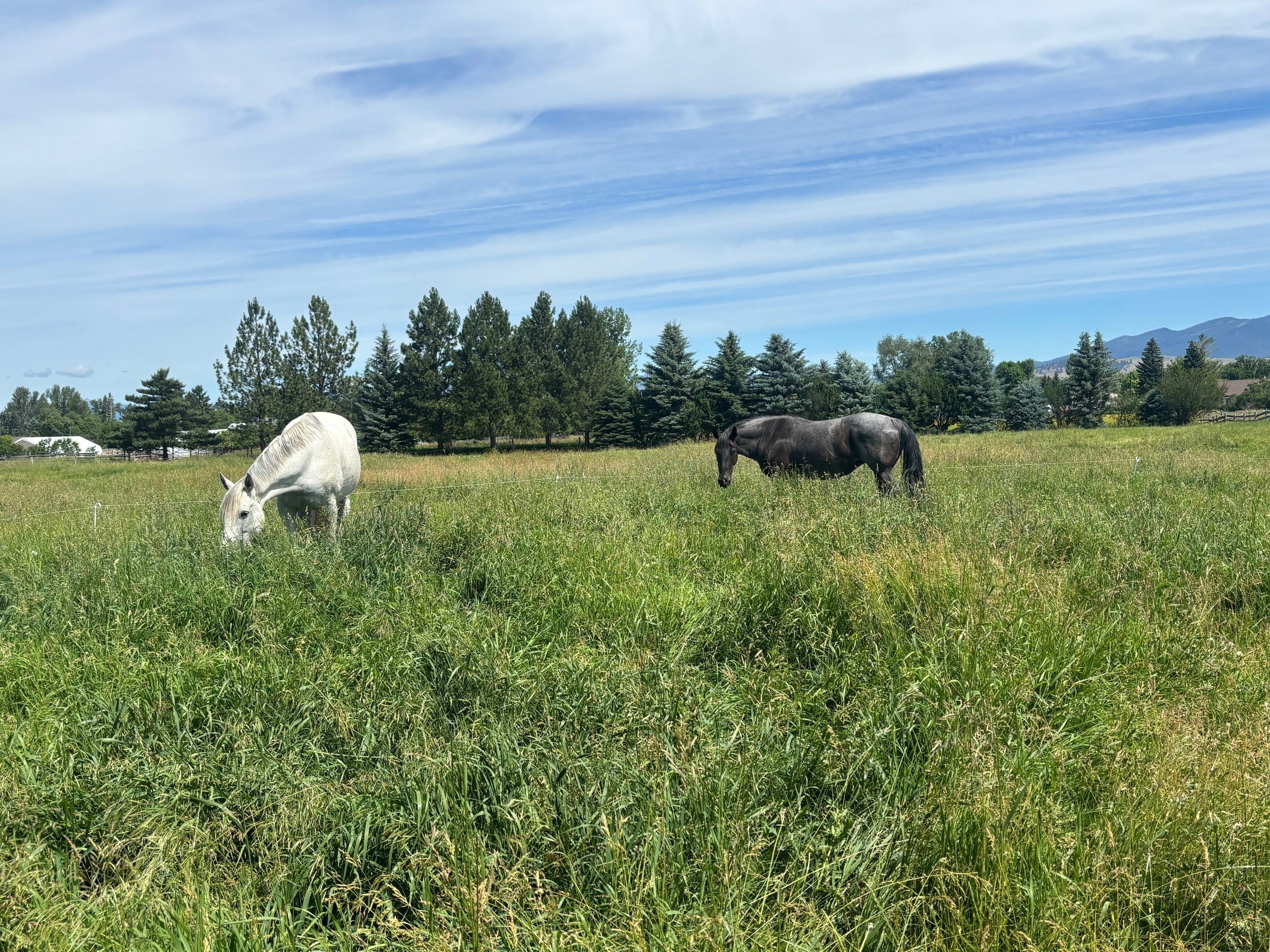
When I think of The Garden Zone, I think of tall, thick stands of waving grass with insects fluttering around. I call it The Garden, because this is where your desirable grasses get prioritized over the horses or livestock for much of the year. The Garden can take any shape or size. It could be a corner, the center of your track system, the far-away pasture, or the entire pasture space. To maintain The Garden in perpetuity, a landowner must nurture and protect it like they would their fruit or vegetable garden by weeding, fertilizing, watering, mowing, and most importantly, protecting it from overgrazing.
This is where your most intense rotational grazing plan is put into place. On my own five acres, The Garden is the back 2.7 acres of pasture. I use temporary electric fence to control exactly where and when and for how long my horses are on each “grazing cell”. It’s a part-time job to move the fences every few days, but I’m rewarded each year with about 9 ton of grazable forage and very minimal weeds. For more information about establishing a rotational grazing system, check out the Missoula County Pasture Evaluation Program resources on THIS PAGE HERE- https://missoulaeduplace.org/what-we-do/livestock-and-equine/pasture-evaluation-program.html
THE GRACE ZONE
There will be mistakes…many of them. That’s why every land management plan needs one or more Grace Zones. I also call them intermediate zones because this is where the needs of the animals, the grass, and the landowner will clash. On my property, I have two major Grace Zones. The first Grace Zone is my front pasture, which is conveniently situated to put a horse or two when I’m lazy, or when friends’ horses come over to visit. It gets overgrazed during the heat of summer. Last winter, when I let the babies out for 10 minutes on a rainy day, they ran around and turned parts to mud. So, there are weeds. A lot more weeds than I’d like, but it’s green, which is nice because it’s next to the road. As you can hear in my writing, I care about it, but not enough to protect it like I do The Garden.
The second Grace Zone is where my rotational grazing strips come back to the waterers. Because I don’t have the time to march horses and water hoses out to far-distant grazing cells, I design each grazing cell so that the horses can always access water and come to the gate. Because of this, the 50 feet around the gate/water are overgrazed and less productive. If you have animals on your property, you are likely thinking of such a space on your own property. This is where we offer ourselves some “grace” to screw up!
THE SUMMARY
Whether you have a rotational grazing plan on your property or not, take a moment to map out your three zones. Perhaps you’re realizing that your entire property is either a sacrifice or an intermediate zone and that this is why you have so many weeds. Is there an area conveniently situated that could be roped off to become The Garden? Maybe your entire property is such a big, dusty sacrifice area, and you’re realizing that you could save some of it for seasonal grazing. The relative size of each zone will vary depending on the goals of the landowner and the size of the property, but EVERY property should have three zones!


