
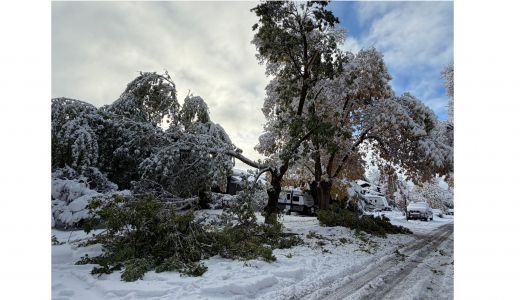
The recent snowfall across Montana arrived before many trees and shrubs had fully dropped their leaves. This can create conditions that can lead to significant branch bending, splitting, and breakage. While snow is a welcome source of moisture, heavy, wet snow can quickly accumulate on leaves and branches, dramatically increasing the weight that young trees and shrubs must support. Trees that normally handle winter snow well may be at greater risk when snowfall occurs before leaf drop because the remaining foliage provides additional surface area for snow accumulation.
|

Why Are Leafy Trees More Vulnerable?
Most deciduous trees reduce their snow load naturally after leaves drop. However, early-season snowstorms can catch trees before the dormancy process is complete. Leaves can act like small shelves that collect snow, increasing the weight on branches. Young trees are particularly vulnerable because they have smaller trunks, less-developed branch structure, and weaker root systems than established trees. Heavy snow loads can result in bent leaders, split stems, broken branches, and permanent structural defects that can impact trees for years to come.
In Montana, species that commonly retain leaves longer into fall, as well as newly planted ornamental and fruit trees and shrubs, may be especially susceptible to damage from October snowstorms.
Trees and shrubs holding onto leaves can be under significant stress from heavy snow load. Photos: Sarah Eilers |

What Should You Do?
If branches are heavily weighed down by fresh snow:
- Carefully remove snow from small, reachable trees and shrubs using a broom.
- Brush upward from beneath the branch rather than pushing downward from above, which can increase breakage.
- Start with lower branches and work gradually upward.
- If snow is frozen into ice, allow it to melt naturally rather than attempting removal. Beating or shaking ice-covered branches can cause additional injury.
For young trees:
- If possible, gently remove excess snow before branches become permanently bent.
- Monitor central leaders for bending or splitting.
- Avoid pulling branches back into position while frozen.
- Newly planted trees should be evaluated once snow melts to determine if staking or corrective pruning is needed.
What NOT to do:
- Do not hit branches to dislodge snow.
- Do not aggressively shake frozen branches.
- Do not attempt to remove ice accumulations.
- Do not attempt to tackle tree issues that you are not comfortable handling safely!
Younger trees and shrubs that have less developed branch structure or root systems can be even more suceptible to damage under heavy snow loads. Photos: Sarah Eilers |

After the Snow Melts
Once branches are exposed, inspect trees and shrubs for:
- Cracked or split branch unions
- Broken leaders
- Hanging branches
- Trunk wounds
- Permanent lean or bending
- Cracked or split branch unions
- Broken leaders
- Hanging branches
- Trunk wounds
- Permanent lean or bending
Prune broken branches using proper pruning cuts and remove hazards promptly. Trees with major structural damage, large split stems, or branches near utility lines should be evaluated by a certified arborist. Proper pruning helps reduce future pest and disease problems by allowing wounds to seal more effectively.
|

When in doubt, reach out to an ISA Certified Arborist for assistance, hazard tree assessments, and recommendations.
This storm serves as a reminder that our weather can be challenging for our trees and shrubs, and winter injury is not always caused by extreme cold. In Montana, early-season snow arriving before leaf drop can create substantial mechanical stress on trees and shrubs. If you have young trees or plants that are still carrying leaves, take a few minutes to inspect them and carefully remove excessive snow where it can be done safely. A little attention now may prevent years of structural problems later.
Questions about tree or shrub injury?
Abiya (Abi) Saeed
abiya.saeed@montana.edu
abiya.saeed@montana.edu
Photos: Sarah Eilers
Contact your local MSU Extension office for assistance.
Sarah Holden, Missoula County Extension
406-258-4205


