
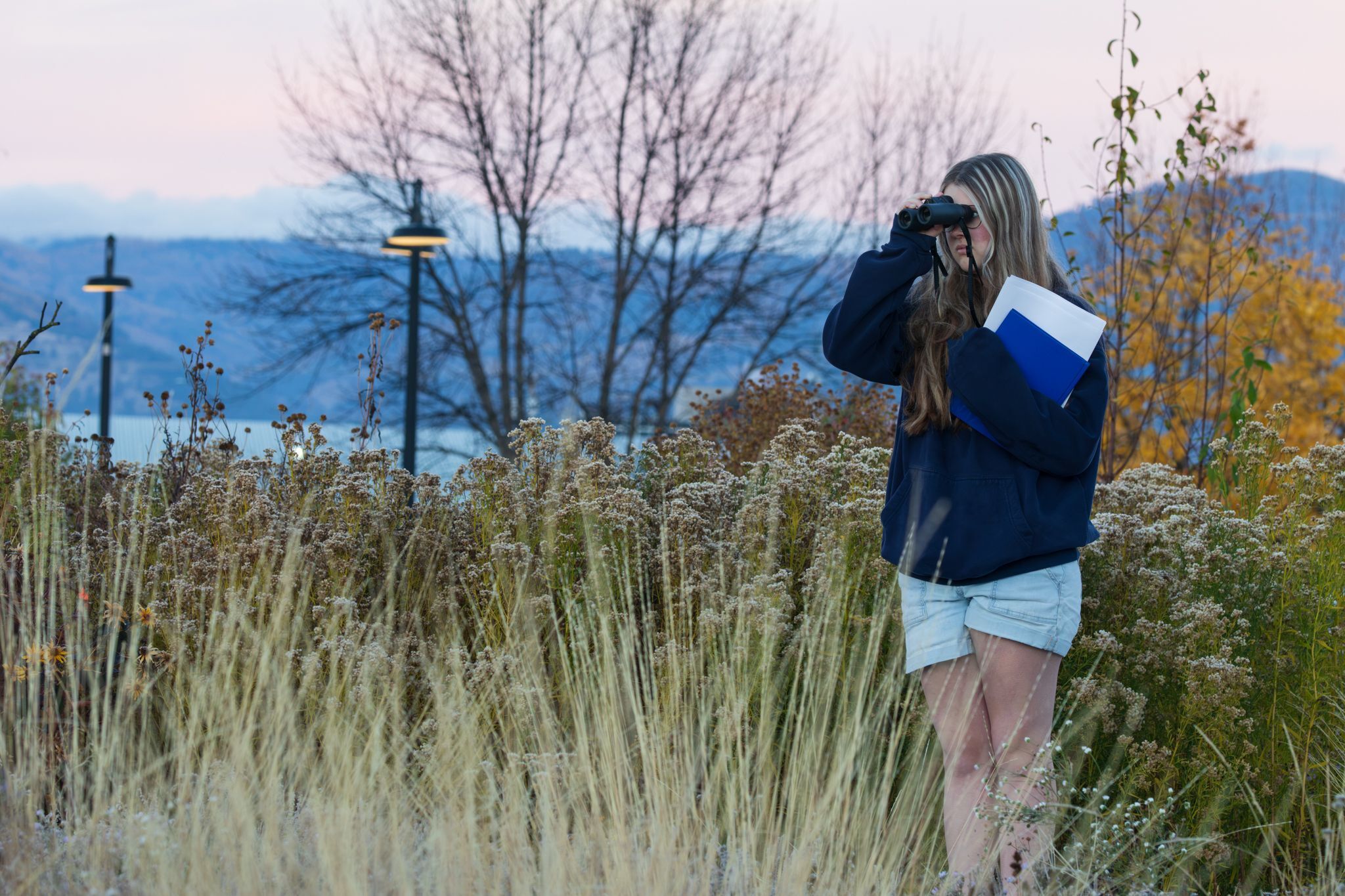
Hi! My name is Annabelle Brock and I am a junior at Sentinel High School in Missoula Montana and this year I had the opportunity to take a class called APS. APS stands for Advanced Problems in Science and it's a class where you spend all year on a science project of your choice. My project aims to explore the differences in bird population, frequency and species diversity between three separate green spaces in Missoula.
These spaces are the east lawn of Sentinel High School, Lions Park and Rocky Mountain Gardens. These spaces are all in close proximity yet have very different features and characteristics. Sentinel High School is a grassy lawn with young trees and gets occasional use mostly by dog walkers in the summer. Lions Park is a big grassy space with mature trees, a playground, picnic tables and is used frequently during the summer for many types of outdoor activities. Rocky Mountain Gardens is a botanical garden housed at the Missoula County Fairgrounds that has a diverse array of plants from native species to food plants like tomatoes. The Gardens is open to the public only during set hours (Missoula County Department of Ecology & Extension). My idea is that looking at how many and what types of birds are frequenting each space, that can better inform plans for future green spaces.
For the past 3 months I have been going once every 2 weeks on Sunday mornings to observe each space for 30 minutes each and collect data. I have noticed a large group of birds at Rocky Mountain Gardens, a large group at Lions Park, and a very small group at Sentinel. I often find myself sitting at Sentinel staring at one singular crow or magpie for the entire frame, so it's safe to say Sentinel observations are not my favorite.
Alternatively, I really enjoy my time at Rocky Mountain Gardens with Jill Leblow. The bird group is extremely diverse and it's just a pretty space to be in general. Occasionally, I’ll see wildlife other than birds in the gardens like mice or bunnies. It's fully possible that seeing the bunnies could affect my data because it takes my full attention away from the birds. Working with Jill has been an amazing experience. Getting to learn from someone who is so passionate and knowledgeable about birds has been extremely beneficial and I learn a little bit more every time. The bird group at the gardens is heavily composed of sparrows, finches, crows, pigeons and geese. When I originally started collecting data in August, I never witnessed geese but now that winter is approaching it's not uncommon for me to see them in huge groups flying over.
Lions Park is a slightly different experience. I do Lions Park observations on my own so I rely heavily on bird identification apps like Merlin for identifying bird calls. I’ve gotten a lot better at visual identification but I still struggle at identifying based on sound, they all sound like sparrows to me. At Lions Park I mostly see black-billed magpies, crows, pigeons, chickadees, finches and waxwings. I sometimes struggle with external factors there, such as families and loud cars which can scare away birds.
Overall, I’ve learned a lot about all sorts of things. Before my project, I didn’t know nearly as much about birds as I do now. I’ve also gotten to see some birds that I consider to be favorites of mine. I’m a big fan of the Black-capped Chickadees I'll occasionally see. I find their iconic call to be somewhat nostalgic as something I heard a lot as a child growing up in Montana. I also enjoy the Dark-eyed Juncos, whose large black pupils remind me of the Beenie Babies I had as a kid. Overall, the study has allowed me to view bird populations as something that are complex and interesting, and it's also established a firm love of birds that I hope to carry with me even after the studies end.


