
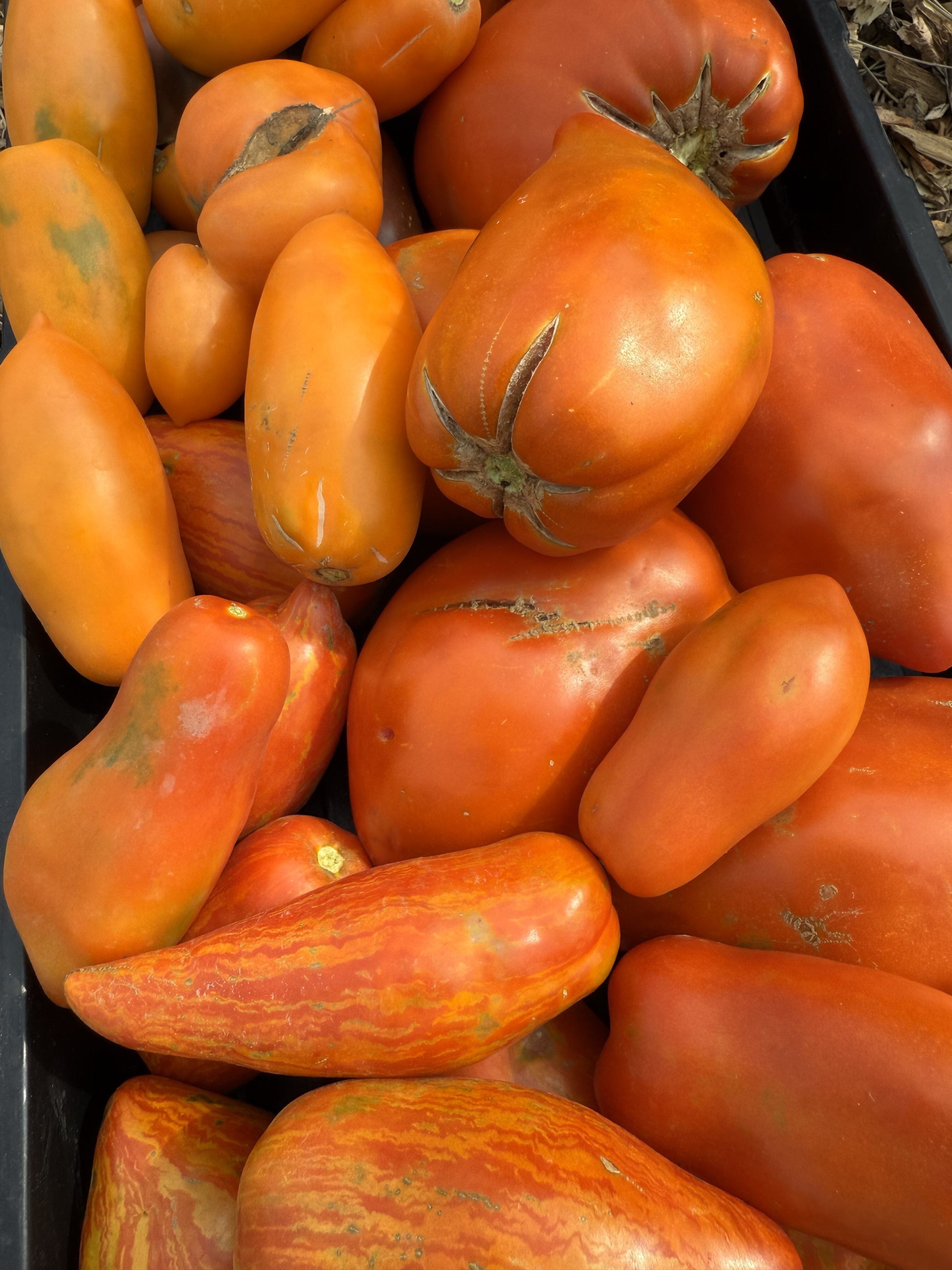
During the 2025 growing season, 12 varieties of paste-style tomatoes were grown in the Rocky Mountain Gardens’ Trial Gardens. We chose paste tomatoes due to our curiosity around the misconception that paste tomatoes are one-dimensional, i.e., their propensity for processing into sauce and paste makes them undesirable for fresh eating. Furthermore, selecting a particular tomato style helps us to narrow our options and provide a specific variable for comparison.
Objectives
- Analyze tomato varieties for yield, flavor, and climate suitability.
- Provide tomatoes for educational programming.
- Create opportunities for volunteer engagement.
- Create passive education opportunities for garden visitors.
How tomatoes were chosen
We searched far and wide for our selected tomato varieties. The abundance of online seed wholesalers greatly expanded our pool of choices. With a focus on paste-style tomatoes, we chose varieties based on climate suitability, flavor, and interest.
The first qualification was that the variety would produce fruit within our relatively short growing season. To determine this, we sought varieties requiring 90 or fewer days to reach maturity, a metric provided by the seed wholesaler.
Second, we sought varieties good for making paste or sauce. We determined this by reading each variety’s description, making note of those enthusiastically promoted by the producers.
Despite our focus on tomatoes well-suited for cooking and processing, we also sought varieties that were good for fresh eating. This detail was generally included in the producer’s description of the variety.
We also chose tomatoes with an interesting history. Many tomato varieties come from seeds saved for generations in a single family or region. With this in mind, we included varieties from a wide range of regions across the globe.
Finally, the “prettiness” factor. In addition to the standard red, oblong paste tomato, we sought varieties with remarkable color. For these, we identified Pink Fang, Orange Icicle, Speckled Roman, and Russian Lemon. Unfortunately, Russian Lemon was lost somewhere along the way, so we were able to test out the yellow paste variety.
Our final list was made up of the following varieties: Korean Long, 10 Fingers of Naples, Opalka, Blue Beech, Canestrino di Lucca, Anna Maria’s Heart, Speckled Roman, Purple Russian, Orange Icicle, San Marzano, Russian Lemon*, Pink Fang, Plum Regal.
*Russian Lemon went missing in the greenhouse and, therefore, was not used in the actual trial.
The Trial
A group of volunteers, the “Tomato Specialists”, was involved in every step of this trial. After the plants were transplanted into the field in early June, this group congregated weekly to tend the crop by weeding, pruning, trellising , and, eventually, harvesting.
Once the harvest began, the fruits of each variety were weighed, counted, and recorded along with the date of harvest. The initial harvests were small and sent home with these volunteers to taste test. Once the harvests increased, the fruits were used in educational programming both at the Exploration Center and at neighboring Sentinel High School.
The following methods were used to control variables that might influence the growth and output of each plant:
- Same date of seeding, potting-up, and transplanting outdoors
- Seedlings were grown in the same soil mix
- Watering was standardized by using a drip irrigation system on a schedule
Findings
At the close of the season, the harvest data was analyzed by one of the tomato specialists. The collected data allowed us to evaluate many different aspects of our trial. A few key points included: total yield by weight per plant by variety; average fruit weight by variety; early-, mid-, and late-season producers. We also held various taste-tests in which people could choose their favorite varieties for fresh eating.
Of our 12 varieties, Plum Regal had the highest rate of production with an average of 23.7 pounds of fruit per plant. The runner-up was Canestrino di Lucca, producing 15.6 pounds of fruit per plant. The lowest producer was Korean Long, producing 3.6 pounds per plant. Taking all varieties into consideration, plants produced on average 10.4 pounds of tomatoes.
The fruit weight varied significantly. The largest tomatoes came from the Gopak variety, with fruits averaging 13.5 ounces each! 10 Fingers of Naples produced the smallest fruits, averaging 1.8 ounces each. Across the board, the average fruit weight was 4.7 ounces.
We harvested tomatoes for eight weeks, beginning August 12 and finishing September 30 , due to imminent frost. The final harvest included remaining unripe tomatoes in hopes of them ripening indoors, though these were not included in the weights for the final harvest. Most varieties were producing between 10 and 20 ounces of fruit per plant each week by August 26, excluding San Marzano, Purple Russian, and Plum Regal. By September 16, many varieties were exceeding 20 ounces of fruit per plant each week, with Canestrino Di Lucca producing 80 ounces per plant! From the data, we can gather that a few varieties were definitively late producers. These include Plum Regal, 10 Fingers of Naples, Blue Beech, and Anna Maria’s Heart.
Flavor preferences varied greatly from taster to taster. A few top picks included Orange Icicle, Pink Fang, Purple Russian, and Anna Maria’s Heart.
Community Impact
This trial prioritized public engagement. Growing tomatoes provided an abundance of educational opportunities both passively and through organized events.
First and foremost, this trial provided a meaningful volunteer opportunity. As previously stated, our so-called Tomato Specialists were involved in every step of this trial. These volunteers met on a weekly basis to tend the plants. Starting off as strangers, they quickly got to know one another and established a community around the project.
Additionally, we organized a variety of formal learning opportunities focused on tomatoes. A public workshop was held to teach participants how to prune and trellis the plants. Once the fruit was ripe, two additional culinary workshops were held- a canning class and a class on making salsa from scratch.
Finally, we provided ample signage for the public to learn about the project while visiting the gardens. Detailed signs were made for each variety, and workshop opportunities were posted alongside the tomato plants. Given the layout of the gardens, it was easy for visitors to walk through the beds and observe the plants throughout their lifecycles.
Next Steps
Moving forward, we would take more detailed notes on pest and disease issues within the crops, continue to amend the soil in these beds, and continue to provide learning opportunities for volunteers, visitors, and program participants.
We noticed definitive pest and disease impacts on the tomato plants and production. For example, we noticed that Pink Fang and Purple Russian experienced a high rate of splitting. Additionally, most of our varieties experienced high rates of blossom-end-rot. Defying these trends, Plum Regal and 10 Fingers of Naples produced fruit without any apparent blemishes or other issues. We will record these trends with more detail in future trials.
We believe that the current soil quality is a contributing factor with the outcomes of our paste tomato trial. The space was planted with cover crop for the 2024 season and, prior to that, Rocky Mountain Gardens was still under construction. With this in mind, we believe that the soil in this garden area has a long way to go before it reaches optimal fertility. We will continue to test the soil and add amendments in years to come.
Volunteers, visitors, and program participants all responded enthusiastically to this trial. We intend to continue working with our Tomato Specialists next season, and we hope to see the group grow. Interpretive materials will continue to be provided and improved, allowing visitors to glean information during their garden stroll. Finally, we will offer similar programming opportunities in the year to come. This will include a pruning and trellising workshop, as well as culinary opportunities with a focus on tomatoes.
Conclusion
The 2025 Paste Tomato Trial was a success in many ways. Not only did we produce hundreds of pounds of tomatoes, we encouraged horticultural curiosity and community building within the Rocky Mountain Gardens. We are excited to start on the next round of tomatoes in the spring of 2026, and look forward to learning more!


